
Trial-assembly inspection is the factory's final opportunity to catch drawing issues, fabrication deviations and junction clashes before aluminum formwork is shipped. The biggest problem on site is not panel weight, but discovering on the floor that numbers are unclear, holes do not align, corners will not close, opening panels are reversed or special-size panels are missing. The installation crew then has to search for panels while carrying out rework, directly slowing both the first floor and the typical-floor cycle.
For the supplier and project team, trial assembly is not a procedural photo opportunity. It is a systematic check focused on the installation result. The more factory-based the production process, the more thoroughly numbering, hole positions, junction components and packing lists must be checked before shipment. Otherwise, the same problem can be copied across an entire delivery batch.
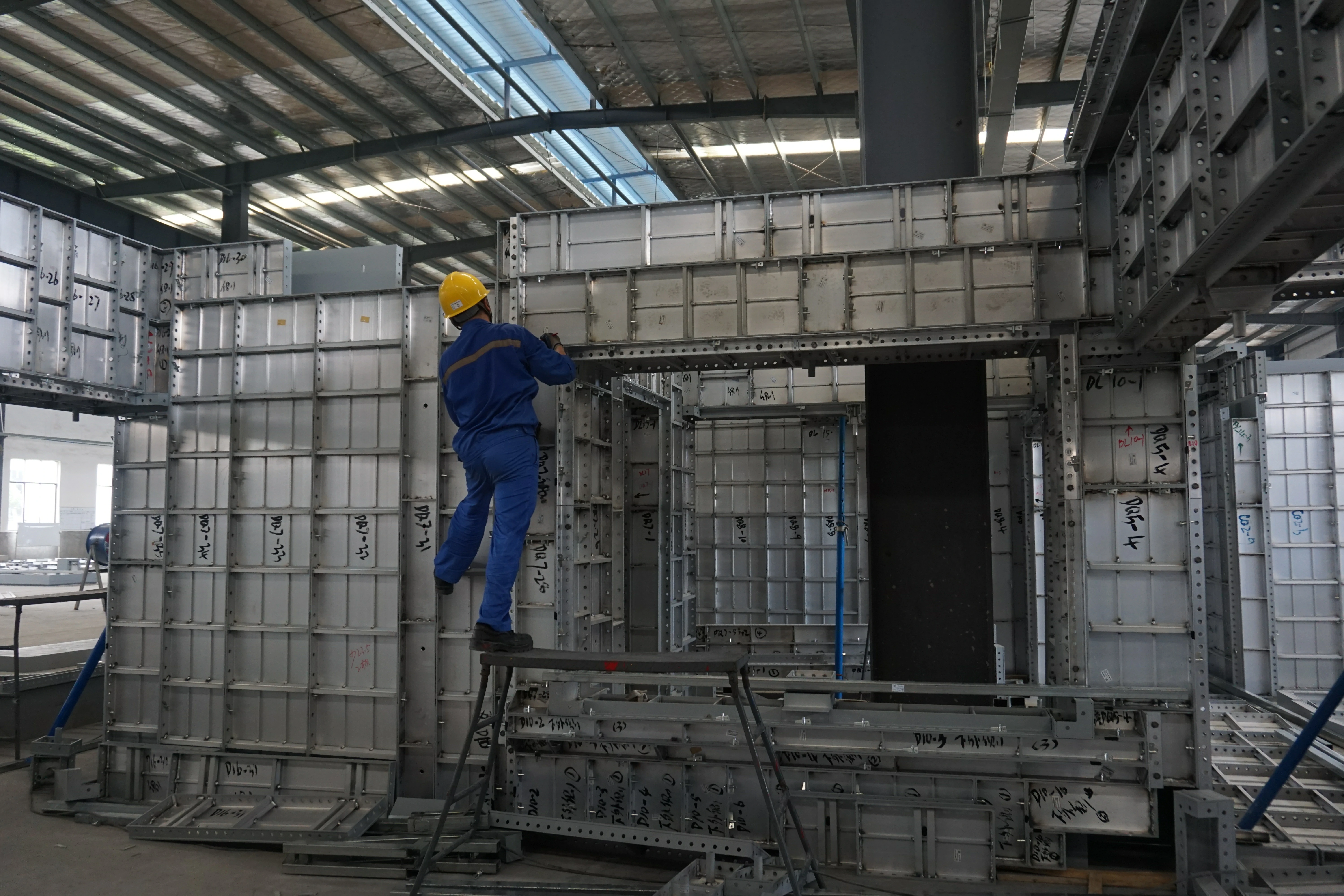
The purpose is not merely to prove that the panels can be joined. It is to verify that the complete batch can be installed, closed, reinforced and reused in accordance with the detailed layout. Inspection should cover four areas: clear numbering, accurate holes, complete junction closure and a complete shipment. Losing control of any one area affects both installation productivity and formed quality.
Disorganized site installation often begins with a disorganized numbering system rather than incorrect panel dimensions. If numbers are discontinuous, markings wear off easily, left and right orientations are unclear, or typical and non-typical floors are mixed during trial assembly, crews end up repeatedly test-fitting similar panels, confusing short and long components, and searching for junction panels.
A numbering inspection should establish more than the presence of a label; it should confirm that the label can guide installation. On wall panels, opening panels, internal and external corner panels, K panels, stair panels and special transition panels, check that the number is conspicuous, orientation is unambiguous, and floor, zone and installation-direction information is complete. A number is useful only when a site crew can identify the component at a glance.
| Numbering check | Main control | Site risk |
|---|---|---|
| Panel number | Matches the detailed drawing and is clearly positioned | Incorrect panel installation and slow panel retrieval. |
| Orientation mark | Clearly distinguishes left/right, internal/external and top/bottom | Reversed installation and misaligned holes. |
| Floor zoning | Typical and non-typical floors are separated | Panels mixed between floors. |
| Junction-panel mark | Opening, corner and closure panels identified separately | Missing panels at critical junctions. |
| Accessory label | Connectors, ties and walers packed by zone | Components are difficult to match after arrival. |
Hole-position problems are among the easiest to expose during trial assembly and the most worthwhile to resolve at the factory. A deviation in a pin, tie or connection hole can prevent a wedge from being inserted, cause edge ribs to clash, force local twisting or lead to makeshift hole enlargement on site. During trial assembly, physically check that holes align freely, their edges are intact, and spacing matches the adjoining panel.
Do not limit the check to standard large panels. Focus on corners, short walls, openings, changes in beam-side depth, stair flights and special transition panels. These junction components, rather than ordinary wall panels, usually determine the pace of site installation. One inaccurate hole at a junction can stop the entire sequence.
Junction inspection, not inspection of individual panels, shows the real value of trial assembly. At minimum, the factory should physically assemble high-risk details such as internal and external corners, door and window openings, short-wall stop ends, beam-to-wall and slab-to-beam interfaces, K panel starting details, stair flights and lift-shaft corners. Poor closure at any of these locations is a common source of site rework.
Three questions should be answered at every junction: Can the panels be installed in their numbered sequence? Do edge ribs and joints fit closely? Is there enough room to install accessories and reinforcement? The fact that panels can be forced together does not mean the junction is buildable. If walers cannot clear the detail, flat ties cannot pass through, or a corner panel only just fits under force, the inspection has not passed.
| Priority junction | Inspection focus | Common problem |
|---|---|---|
| Internal and external corners | Corner-panel fit and smooth hole alignment | Open corner joints and reversed panels. |
| Door and window openings | Closure on all four sides, opening dimensions and orientation | Displaced openings and incorrect side panels. |
| Short-wall stop ends | Straight closure between stop-end and wall panels | Stop-end movement and grout leakage. |
| Beam-wall and slab-beam interfaces | Compatibility of step panels and adapter panels | Offsets and locked-up junctions. |
| Stair junctions | Flight direction and relationship between tread and corner panels | Left/right components mixed and uneven joints. |
Some projects complete a satisfactory factory trial assembly but still face disorder when containers are opened on site. The usual cause is an incomplete pre-shipment system check. Shipping is not finished when the panels are loaded. The team must also verify connectors, ties, walers, prop heads, steel props, push-pull props, stop-end panels, closure panels and packing lists. Packaging zones should match the planned lifting and floor-installation sequence.
A total-quantity check is not enough. Unless packages are divided by building, floor, zone and junction type, the site may receive panels without their accessories or main panels before the critical special components. The impact is particularly severe on the first floor, benchmark floor and first typical floor.
The greatest weakness in trial-assembly inspection is allowing it to become a formality. Effective inspection converts familiar problems into mandatory checks instead of tracing them only after site feedback. Repeated issues include unclear numbers, hole deviations, reversed junctions, omitted special components, inaccurate packing lists and poor protection during handling. A standardized checklist allows the factory to catch most of these before dispatch.
| Recurring problem | Cause | Preventive action |
|---|---|---|
| Unclear numbering | Poor label position or easily worn marking | Use one numbering rule and apply duplicate identification to critical panels. |
| Misaligned holes | Fabrication deviation or inadequate junction checking | Trial-assemble junctions and inspect critical holes component by component. |
| Special panel omitted | Packing list disconnected from the detailed drawings | Recheck shipment by zone and junction type. |
| Junction installed in reverse | Unclear orientation marks | Add internal/external, left/right and top/bottom markings. |
| Extensive site rework | Trial assembly covers only large panel runs, not junctions | Make corners, openings and stairs mandatory inspection details. |
No. The numbering must guide installation, holes must align smoothly, junctions must close properly, and all accessories must be supplied as a complete system.
Internal and external corners, door and window openings, short-wall stop ends, beam-wall and slab-beam interfaces, stair junctions and all special transition panels.
The most common omissions are special junction panels, zone-based packing of connectors and separate identification of critical first-floor components.
A thorough aluminum formwork trial-assembly inspection does not primarily save factory time; it saves the cost of first-floor and benchmark-floor rework on site. Clear numbers help crews find panels quickly. Accurate holes let junctions close smoothly. Complete shipments keep installation moving at the planned pace.
For suppliers and project teams, trial assembly should be an installation simulation before shipment, not a set of photographs for the record. When numbering, holes, junctions and supporting components are checked thoroughly, site installation quality and reuse efficiency normally improve significantly.
Phone: +8618711321769
Email: alame.vicky@gmail.com
WhatsApp: +8615400055585
Address:No.88, Shuntian Avenue, Xiangyin District, Xiangjiang New District Hunan Province

 EN
EN
 RU
RU
 AR
AR
 ES
ES