
The starter panel provides the first reference for aluminum formwork wall installation. When it is positioned accurately, the complete wall formwork can close naturally along the setting-out line. When it is displaced, wall verticality, inter-floor offsets, corner alignment and opening positions may all shift with it. For main contractors and formwork crews, the starter panel is not an ordinary small infill panel; it is the control component for wall-base positioning.
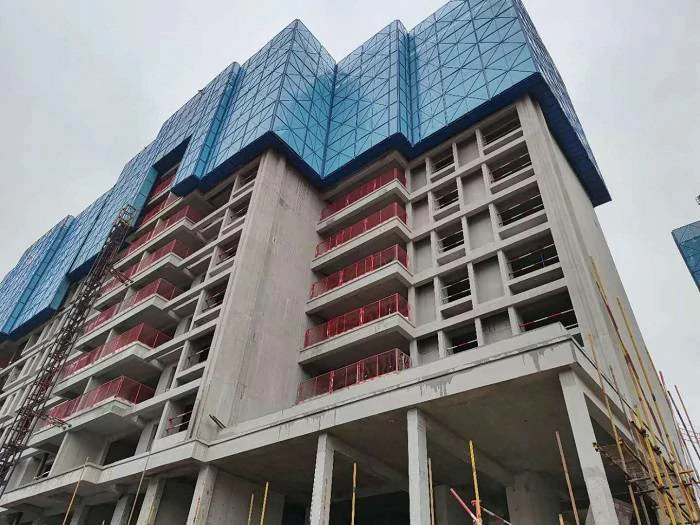
The starter panel has three primary functions: it controls the initial edge line at the wall base, provides the first positioning reference for the complete wall formwork, and reduces grout leakage, offsets and panel movement at the base. Its dimensions may be modest, but it determines whether installation follows the reference line smoothly or requires constant correction.
The starter panel is the point from which the wall formwork is assembled. If that starting point is wrong, the panels continue to close along the error, resulting in a wall that steps inward or outward, corners that are out of square, misalignment between floors and displaced openings. It is tempting to assume that push-pull props can correct the wall later, but in practice they can usually adjust only local areas rather than straighten the entire wall line.
| Starter-detail problem | Site symptom | Downstream effect |
|---|---|---|
| Displaced edge line | Complete wall-panel run is out of position | Out-of-square walls and displaced openings. |
| Incorrect elevation | Uneven bottom edge | Offsets at the wall base and an irregular joint line. |
| Loose joint | Grout leakage at the wall base | Honeycombing and extensive repair. |
Wall-base positioning should not rely on experience alone. Check the structural grid, wall edge lines, wall-thickness lines and level datum together. Before installation, confirm that the starter wall or structural surface is straight and clean. Install the numbered starter panels, align them first, and lock them only after rechecking the lines. Short walls, corners, opening edges and lift shafts need additional measurement because they tend to amplify local errors.
A closure check must go beyond confirming that the panels can be joined. Inspect whether the edge ribs fit closely, all pins and wedges are installed, the bottom joint is even, wall thickness is stable, and corner and opening panels close without resistance. A starter panel that is only forced into place is particularly likely to open at the bottom during concrete placement.
| Inspection item | Main control | Common risk |
|---|---|---|
| Edge-rib fit | Straight contact surfaces with no clashes | Local open joints and offsets. |
| Pins and wedges | Aligned holes and complete installation | Loose formwork and movement during casting. |
| Bottom joint | Even width and tight closure | Grout leakage and bugholes at the wall base. |
| Wall thickness | Stable tie arrangement and clear distance | Wall-thickness error. |
| Junction interfaces | Corner and opening panels close together | Misaligned corners and openings. |
The starter panel sits at the lowest part of the wall formwork, where fresh concrete has its most direct impact. No connector may be omitted, and walers and ties must not terminate at the starting zone. Control the discharge rate to avoid concentrated impact at the wall base, and do not hold the poker vibrator against the starter junction. The formwork watch should focus on the bottom joint, short-wall ends and corner starting points.
| Problem | Main cause | Corrective method |
|---|---|---|
| Grout leakage at wall base | Loose bottom joint or missing connectors | Recheck panel fit and connection completeness, then seal as specified where necessary. |
| Displaced wall | Incorrect starting edge line or displaced starter panel | Remeasure the edge and wall-thickness lines; never close the formwork around an existing error. |
| Offset at bottom edge | Inconsistent elevation or panel not firmly seated | Clean the substrate, recheck the level and reinstall correctly. |
| Difficult closure | Confused numbers, misaligned holes or deformed panels | Install by number and replace damaged components promptly. |
No. It is the starting reference for the wall formwork, and any positioning error is transferred directly into the entire wall.
Check the setting-out line and panel fit first, followed by pins and wedges and the wall-thickness dimension, and finally the corner and opening interfaces.
Check the bottom joint, whether the panel is firmly seated and whether all connectors are installed before considering additional joint-sealing measures.
The starter panel matters not because it is large, but because it determines where wall-form installation begins and which reference controls closure. Accurate wall-base positioning and a thorough closure check provide a stable basis for wall straightness, corner appearance and opening positions.
Construction teams should never treat the starter panel as ordinary infill. Making the initial setting out, wall-base remeasurement, bottom-joint check and junction closure part of the standard routine reduces rework and repair throughout the wall-form installation.
Phone: +8618711321769
Email: alame.vicky@gmail.com
WhatsApp: +8615400055585
Address:No.88, Shuntian Avenue, Xiangyin District, Xiangjiang New District Hunan Province

 EN
EN
 RU
RU
 AR
AR
 ES
ES