
Slow panel retrieval on an aluminum formwork site is often caused not by an inexperienced crew, but by panel numbers, packing and lifting sequences that were never connected into one workflow. The purpose of numbering is not simply to give every panel a code. It is to let storekeepers, site engineers, foremen and the supplier use the same language to locate each component. On fast-cycle typical-floor projects, numbering is the site navigation system. When that navigation is clear, wall and column panels, beam and slab panels, corner panels, walers, pins and wedges, and supports can reach the floor in step with the installation sequence.
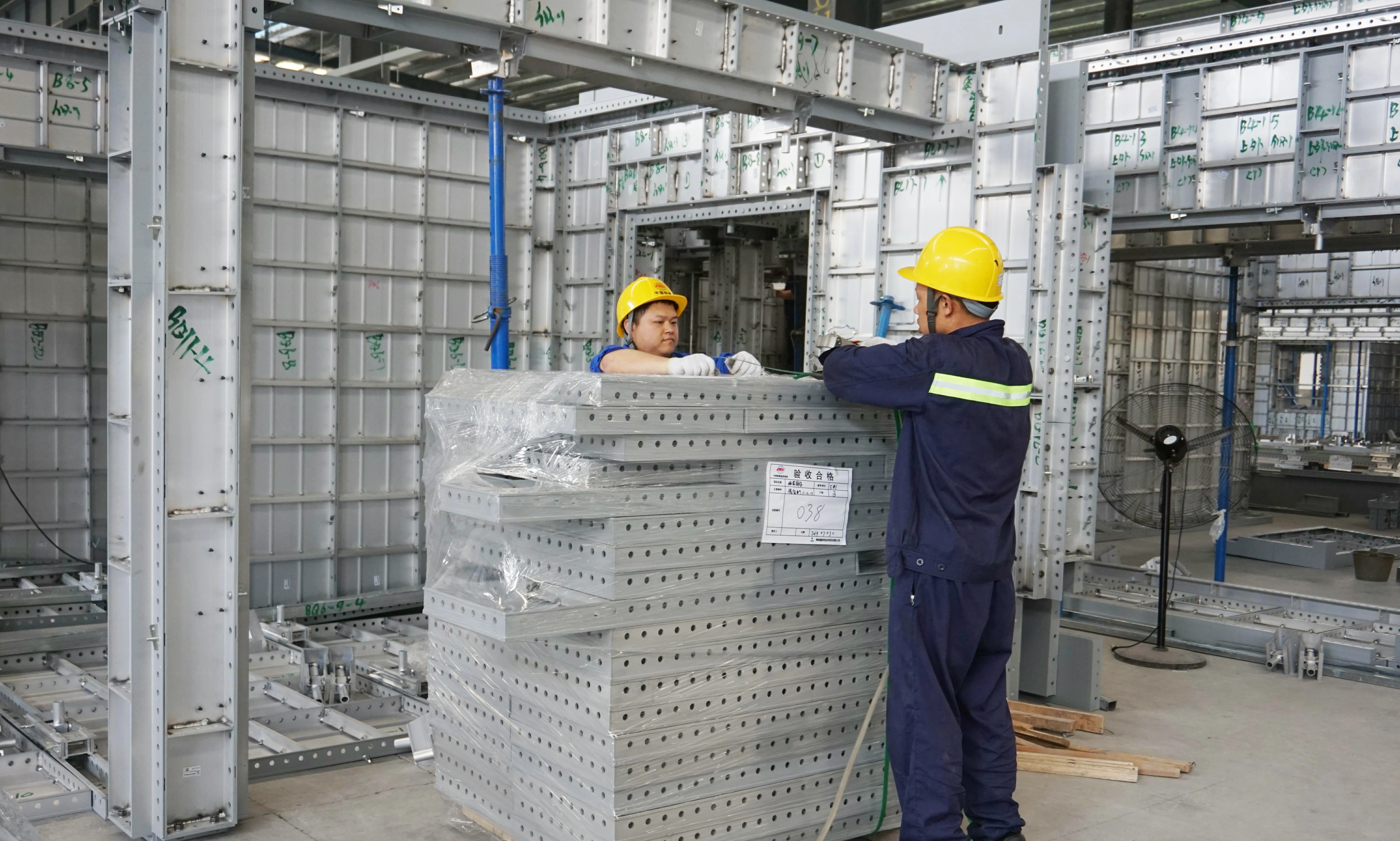
When a crew cannot find a panel on the floor, three reactions usually follow: unpack and search, ask someone, then borrow a panel temporarily. Searching wastes lifting time, asking depends on individual experience, and borrowing creates a shortage in the next zone. Solving the problem requires a numbering system designed around site movement, not merely factory labels.
A practical code can follow the pattern “Building-Floor-Zone-Component-Sequence-Revision.” Zone and component type matter most because installation does not follow one master list; it progresses through walls and columns, beams and slabs, stairs, openings and junctions. The closer the numbering follows the installation order, the less panel retrieval depends on memory.
A packing list that records quantities only still leaves the site to sort everything again. A better approach organizes the list by lifting batch: wall and column formwork first, beam and slab formwork second, junction components and miscellaneous accessories clearly separated, and consumables packed independently. Materials can then be lifted according to the installation route as soon as they arrive.
At minimum, the list should show crate number, bundle number, number range, component category, applicable floor, applicable zone, quantity and weight. Procurement teams can also request a sample packing list before shipment to identify in advance whether panels may arrive without a clear wall location.
First, install storage signs by building, floor and zone. Second, place wall and column components, beam and slab components, supports and connectors in separate areas. Third, move any panel that cannot be matched to the panel layout into a holding area for verification. Fourth, brief the foreman, storekeeper and site engineer using the same numbering sheet.
These four actions take some preparation time, but they reduce later searching, incorrect installation, missing panels and rework. On accelerated projects, establishing the material-to-location mapping on the day of arrival is usually more economical than spending several days correcting disorder.
| Stage | What to verify | Common mistake | Improvement action |
|---|---|---|---|
| Numbering | Floor, zone, component and revision | Sequence number only | Renumber according to the installation route |
| Packing | Crate number, number range and lifting batch | Quantity counted without installation logic | Bundle by formwork system |
| Storage area | Separate zones for walls/columns, beams/slabs and accessories | Mixed stacks requiring repeated searching | Install location signs |
| Changes | Replacement-panel revision and issue record | Old and new panels mixed | Update every related list |
No site should expect every worker to memorize the complete numbering system. A more realistic method combines colors, zone signs and component codes. Use different color bands for zones on the same floor, distinguish wall panels, slab panels, beam soffit panels and corner panels within each zone, and store junction components together.
This approach is particularly effective on repeated typical floors. After stripping, materials should not simply return to a general storage area; they should be arranged as complete sets in the installation order for the next floor. When the return route and issue route are planned together, numbering becomes part of reuse efficiency rather than a paperwork exercise.
Where several crews work across the same floor, the briefing sheet can also identify crew responsibility zones. If one team handles walls and columns, another beams and slabs, and a third junction infill, materials are less likely to cross paths repeatedly. Numbering is not about creating more forms. It makes responsibility, location and installation order visible.
Many projects have a complete numbering rule that never leaves the site office. An effective briefing uses one panel layout, one packing list and a set of physical components to demonstrate how the first part of the code identifies the zone, the next part identifies the component, and the revision identifies its change status.
There is no need for excessive theory. Explain three site actions: which crate or bundle the panel comes from, which zone it should go to, and where it should be sent after stripping. If the crew can follow those three steps, the numbering system has entered the construction rhythm instead of remaining in a folder.
The greatest confusion after a design change comes from old and new panels existing at the same time. If an opening adjustment, local special-panel replacement or corner repair retains the original number, the crew can reinstall an old panel in the new location and create joint, cross-sectional or verticality errors.
Manage revisions separately. The original panel can be V1, the first replacement V2, and a repaired panel should carry a repair-status mark. The packing list, replacement-panel list and site issue record must be updated together. Verbal notice or a screenshot from a chat is not enough.
Numbering requires supplier cooperation. The CIEZN aluminum formwork system organizes the panel, support, connection and reinforcement systems as one package. Walls, slabs, columns, beams, stairs, balconies and door and window openings can all be incorporated into project-specific design. This integrated product structure makes it easier to connect panel layouts, packing lists and the site installation sequence.
Service matters even more. CIEZN provides secondary panel-layout design, installation training and on-site technical guidance, together with a standardized service response. During the inquiry stage, procurement teams can request its numbering rules, sample packing lists, site briefing method and replacement-panel revision controls. These factors often reduce delivery risk more effectively than comparing price per square meter alone.
Construction companies planning to reuse their aluminum formwork can also ask the supplier to design numbering for later cycles. Standard panels should retain stable numbers where possible, special and changed panels should be marked separately, and repaired panels should keep a condition record. This makes secondary panel design easier when used panels move to the next project.
If you are preparing an aluminum formwork purchase, consider changing the request from “send me a quotation” to “send me a panel retrieval plan.” The plan should include the numbering rule, panel-layout index, sample packing list, floor-zoning method, initial-installation bundle arrangement, replacement-panel revision rule and site briefing plan.
Projects comparing a CIEZN proposal can provide the building arrangement, floor-to-floor height, number of typical floors, work-zone divisions and planned delivery date, then request a response covering the product system, packing logic, installation guidance and replacement-panel response. A supplier that can explain this chain clearly is more likely to deliver fast retrieval, fast installation and efficient reuse on site.
This discussion also reveals differences in supplier capability at an early stage. A supplier that provides only a price often leaves the operational risk on site. One that connects numbering, packing, briefings and replacement panels is much closer to providing a genuine one-stop aluminum formwork solution.
Contact CIEZN for a solution suited to your project, and let CIEZN become your most reliable one-stop aluminum formwork solution provider.
Phone: +8618711321769
Email: alame.vicky@gmail.com
WhatsApp: +8615400055585
Address:No.88, Shuntian Avenue, Xiangyin District, Xiangjiang New District Hunan Province

 EN
EN
 RU
RU
 AR
AR
 ES
ES