
Choosing the proper aluminum formwork system really affects how profitable a project ends up being in the end. Aluminum formwork is a modern construction approach made for rapid-cycle concrete casting, strong dimensional accuracy, and steady surface output. In many global construction markets, developers, contractors, and EPC companies are gradually moving away from timber or steel formwork, mainly because aluminum brings better long-term value, quicker schedule turnaround, and less dependence on heavy labor.
Still, when someone buys aluminum formwork, it is not only a straightforward product matter. It’s more like a project-critical commitment. If the selection is wrong, you can get design mismatches, unexpected site delays, leakage during pouring, troublesome on-site assembly, and ultimately elevated lifecycle expenses. When the selection is right, it tends to speed up construction, cut down rework or waste, improve the final concrete finish, and generate a steadier ROI when the system gets reused again and again.
This article summarizes the top five things buyers should review before purchasing aluminum formwork for the next build. It also provides a practical buyer checklist plus a supplier assessment table, so procurement teams can decide with more confidence, even under time pressure.
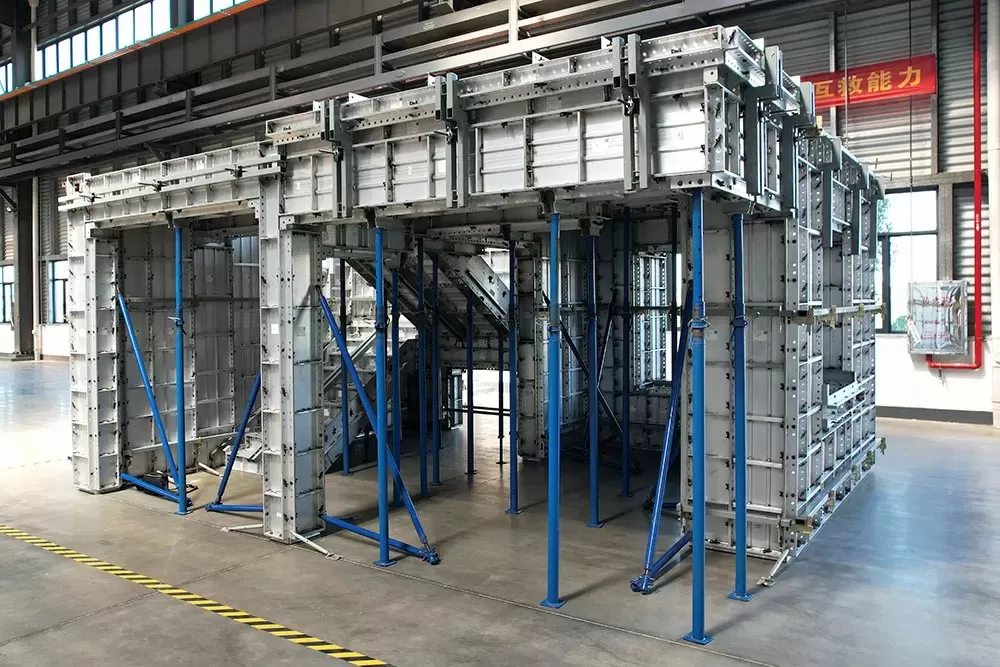
The first and, honestly most important factor is whether the aluminum formwork system matches your actual project needs. Aluminum formwork is not some off-the-shelf commodity. It’s really an engineered system tied to the project, so it has to line up with the structural and architectural drawings.
For residential towers that repeat the same scheme over and over, modular systems can deliver great cycle efficiency. But for projects with irregular geometry, a custom-designed formwork solution is basically unavoidable to avoid excessive modifications on site.
A poorly matched system introduces serious risks, such as misalignment, concrete leakage, weak surface finish, labor inefficiency, and schedule overruns. Before anyone buys, it’s worth asking for engineering layout support, 3D modeling, or even formwork simulation drawings to confirm the fit, before construction starts, and before it becomes expensive to fix.
The performance of aluminum formwork kinda depends on material quality and manufacturing accuracy, a lot. In practice, the grade of the aluminum really drives how it behaves over time. High strength aluminum alloys like 6061-T6 are often used for structural safety, rigidity, and a long service life. And the alloy grade, it influences deformation resistance, the load bearing capacity, and even how many times the system can be reused without trouble.
Precision manufacturing is equally important. CNC machining, along with automated welding, supports tight tolerances, smoother assembly, and consistent panel quality. This directly affects concrete wall alignment, slab flatness, and the final finish quality.
Lower quality systems can deform after repeated pours, which leads to repair expenses, a less attractive concrete appearance, and shorter overall service life. So buyers should request material test reports, load testing data, and quality inspection documentation before placing an order.
One of the biggest perks of aluminum formwork is the high reuse frequency. Timber formwork tends to degrade fast, while steel formwork is typically heavier and also more labor-intensive. Aluminum formwork ends up kind of in the middle, with good strength, manageable weight, and long-term economy.
A high-quality aluminum formwork system can typically be reused 200–300 times with proper maintenance. This dramatically reduces cost per use and improves total project profitability.
When looking at cost, it helps to look past the initial unit price and really estimate things like:
So even if one system feels expensive at the start, it might still deliver a far lower total lifecycle cost, as long as it keeps working reliably across many cycles. For procurement teams, the key metric is not purchase price alone, but the total cost of ownership.
Aluminum formwork is widely recognized for helping projects achieve faster floor cycles. In optimized applications, it can support construction speeds of around 4 to 7 days per floor. This is a major advantage for developers and contractors working on repetitive high-rise or mass housing projects.
A system that is lightweight, easy to assemble, and supported by clear installation procedures can significantly reduce dependence on highly specialized labor. This is especially valuable in markets facing labor shortages or variable workforce skill levels.
Buyers should ask suppliers for installation videos, actual project case studies, and proven floor cycle data to validate efficiency claims.
Choosing the right supplier is just as important as choosing the right system. Aluminum formwork procurement is not simply a hardware transaction—it is a full engineering and service partnership.
Weak supplier support can lead to design mismatches, late corrections, installation errors, and costly project delays. For international buyers, export capability is also essential. Suppliers should demonstrate stable lead times, secure export packaging, efficient container loading, and real-world experience in overseas housing, commercial, and infrastructure projects.
Buyers should also verify quality certifications, inspection procedures, and previous export references before making a final decision.
Before placing an order, use this checklist to verify whether the system and supplier meet your project requirements.
| Evaluation Criteria | What Buyers Should Check | Why It Matters |
|---|---|---|
| Project Compatibility | Drawing-based design, custom layout capability, opening details | Ensures proper fit and avoids on-site modification |
| Material Quality | Alloy grade, strength reports, panel thickness, reinforcement | Affects safety, durability, and deformation resistance |
| Manufacturing Precision | CNC processing, welding quality, dimensional tolerance | Improves assembly speed and concrete finish quality |
| Reusability | Expected reuse cycles, repair frequency, wear resistance | Determines long-term ROI and cost per use |
| Efficiency | Panel weight, locking mechanism, demolding speed | Supports faster floor cycles and lower labor demand |
| Technical Support | BIM/CAD design, installation guidance, training | Reduces errors and accelerates deployment |
| Quality Assurance | Certifications, testing records, inspection process | Confirms reliability before shipment |
| Export Capability | Packaging, container loading, lead time consistency | Minimizes logistics risk for international buyers |
| After-Sales Service | Spare parts, troubleshooting, response speed | Protects project continuity after delivery |
| Commercial Value | Full-scope quotation, lifecycle cost analysis | Helps buyers compare value beyond unit price |
Many procurement issues arise not from the product itself, but from incomplete evaluation. Buyers should avoid these common mistakes:
These mistakes often lead to rework, delays, higher labor costs, and lower-than-expected reuse rates.
We can look at the right aluminum formwork system as more of a productivity engine, not just some one-time purchase. When the system is properly designed, it tends to reduce labor input, improve pour quality, shorten schedules, minimize finishing work, and support repeat use across multiple projects.
Compared to aluminum formwork with timber and steel alternatives, the longer-term upsides start to show up pretty clearly:
For buyers running high-rise, residential, commercial, or infrastructure projects, these advantages translate into steadier execution and help protect project margins, even when the schedule gets tight.
When buying aluminum formwork for your next project, the call shouldn’t depend on price only. The five most important factors really are structural compatibility, material quality, reusability, construction efficiency, and supplier support. If you look at them carefully, you can prevent expensive missteps and also keep performance stable across the whole project lifecycle, not just at the start.
A good aluminum formwork system does more than concrete shaping. It improves speed, precision, durability, and profitability. For serious B2B buyers, the most sensible procurement approach is to mix technical due diligence with a supplier capability check and a lifecycle cost analysis. Otherwise, you may save money upfront but lose it later, in a very quiet way.
If you are planning a residential tower, a commercial development, or some infrastructure work, a customized aluminum formwork solution can help you reach faster builds, better surface finishes, and stronger ROI. It’s more than a product, it is practically a workflow advantage.
For project-specific engineering consultation and quotation support, feel free to contact us.
Phone: +8615400055585
Email: pd13579@qq.com
WhatsApp: +8615400055585
Address:No.88, Shuntian Avenue, Xiangyin District, Xiangjiang New District Hunan Province

 EN
EN
 RU
RU
 AR
AR
 ES
ES